
Domestic Rice News
Removing barriers to rice exports gives small businesses more opportunities
01
Oct
Oct
TPO – From October 1st, the conditions for exporting rice have been reduced, opening up more opportunities for businesses to participate in the market, especially in the organic rice and processed product segments.
Opening more doors for small businesses
From October 1st, Decree 365 on rice import and export business officially came into effect, reducing the business conditions from 3 to 2, while simplifying documents and shortening the licensing time.
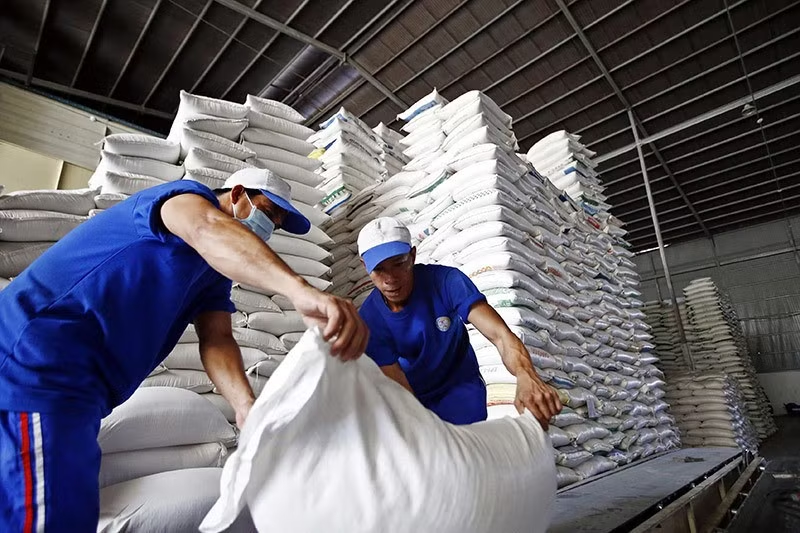
Accordingly, ordinary rice exporters must have at least one dedicated warehouse for storing paddy and rice, and a milling facility that meets food safety regulations, standards, and technical specifications. Businesses can lease these facilities instead of having to invest in or own them themselves.
Notably, with organic rice, parboiled rice, and micronutrient-fortified rice, traders can export without needing a certificate of eligibility to export rice, without having to maintain circulating reserves and reporting requirements like regular export traders.
This change opens up more opportunities for businesses that develop specialized products and have international customers but lack the resources to invest in large-scale warehousing and milling systems. Instead of focusing resources on infrastructure, businesses can concentrate on improving quality, building raw material areas, and developing their brand.
Another new feature is that only traders with a certificate of eligibility to export rice are eligible to receive export authorization. Through this process, businesses that do not yet meet the requirements for direct export can still access the market through cooperation with licensed entities.
The easing of business conditions comes as Vietnam’s rice industry is under price pressure and demands a shift in its growth model.
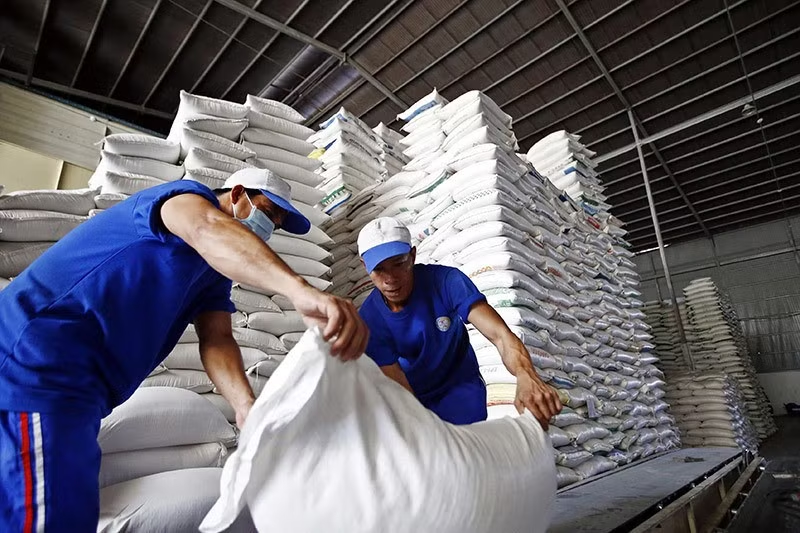
According to the Ministry of Agriculture and Environment, in the first eight months of 2026, Vietnam’s rice exports are estimated at 6.03 million tons, worth nearly 2.9 billion USD, a decrease compared to the same period last year. The average export price reached approximately US$481.5 per ton, a decrease of 5.9%.
The fact that export turnover is declining faster than output shows that maintaining a large export scale is not enough to guarantee economic efficiency. In the context of increasing competition, developing high-quality, branded, and value-added rice varieties has become a crucial direction.
Not only should you sell a lot, but you also need to sell at a high price
Mr. Nguyen Quoc Manh, Deputy Director of the Department of Crop Production and Plant Protection, Ministry of Agriculture and Environment, believes that the advantages of Vietnamese rice lie in seed quality, the shift towards fragrant rice and specialty rice, the organization of raw material areas, and the ability to consistently meet orders for large markets.
According to Mr. Manh, the project to cultivate 1 million hectares of high-quality, low-emission rice in the Mekong Delta will help create a uniform, traceable supply of goods, meeting the needs of high-end market segments.
This also provides a platform for small businesses to develop value-added products, instead of competing directly with large exporters in terms of production volume and selling price. However, establishing a high-quality production chain still faces many obstacles.
According to the Department of Crop Production and Plant Protection, by August 2026, the area covered by all or part of the sustainable farming process under the 1 million hectare rice project reached 420,813 hectares, but the area covered by all criteria had only reached 67,648 hectares.
Major bottlenecks remain in irrigation infrastructure, inland transportation, drying, storage, logistics, access to credit, and the cooperative’s capacity for linkages. Brand building, certification, and price differentiation for high-quality, low-emission rice are also still limited.
